


On February 19th, at the United States Institute of Peace in Washington, a group of heads of state, ministers, military officials and financial actors gathered for the first official operational meeting of the Board of Peace (BoP).
A few months ago, this structure did not exist. Now it has capital, legal standing, and a deployment plan.
The Board of Peace is not a UN agency (but operates with UN Security Council approval), not a traditional coalition, not a development bank. Yet it borrows elements from all of them.
The meeting began with the usual diplomatic courtesies: public praise, expressions of gratitude, acknowledgment of contributions. Then the discussion moved into operational detail.
Donald Trump framed the tone in his quite recognizable style:
"This is so little talk. This is very little talk. All action."
He emphasized that the Board does not merely convene countries, but "devises and implements."
After that, Gaza entered the discussion as an implementation environment:
- An International Stabilization Force structured in brigades and sector assignments.
- A transitional Palestinian authority with defined security priorities.
- Full demilitarization presented as a precondition for reconstruction.
- A reconstruction fund structured through the World Bank.
- A $10 billion US financial commitment.
The contrast with traditional UN processes is difficult to ignore... For decades, Gaza has been managed through UN mechanisms, including UNRWA structures, humanitarian aid cycles, and donor conferences.
UNRWA was created as a relief agency, not a political settlement mechanism. Its mandate is humanitarian: education, healthcare, food assistance and social services.
It does not restructure sovereignty. Refugee status under UNRWA is hereditary, which means the system expands demographically rather than resolves itself politically. It is not a durable political solution.
The format presented on February 19th follows a very different logic.
Gaza functions as a proof-of-concept environment for a new coordination format. If Gaza stabilizes under this format, the model becomes replicable. If it fails, it remains a political experiment. In either case, the structure itself deserves analysis.
Because what emerged is a coordination platform that bundles security enforcement, capital allocation and governance transition inside one execution container.
And that raises a structural question:
What kind of world produces governance containers like this?
This brief is going to break down:
1) The emergence of an "unidentified political object": what the BoP actually is (the charter mechanics)
2) Is the BoP an alternative to the UN?
3) Why this political object is emerging now
4) From institutions to platforms
5) Why this matters for leaders and capital
What the Board of Peace actually is: the Charter mechanics
1) Legal anchoring and jurisdiction
The BoP's primary legal anchoring is American.
The Charter does not formally fix a headquarters. It allows the Board to negotiate seat agreements with host States.
When Donald Trump designated it as a "public international organization" under U.S. law, he effectively placed it within the framework of the International Organizations Immunities Act (IOIA).
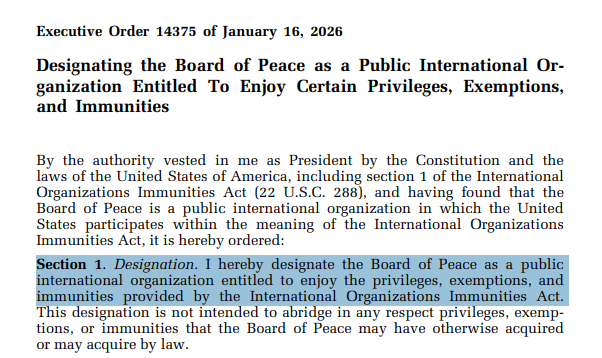
It means the BoP's first layer of reality is U.S. law. It is an international body hosted by a sovereign power and tied directly to the US executive branch (not congress).
2) A highly personalized institution
The most structurally revealing feature of this charter is the role of the Chairman: for now, Donald Trump.
Entry, continuity, and dissolution all pass through his office. The Chairman sits at every critical junction. Clearly not a rule-driven multilateralism. Power flows through a person before it flows through procedure.
International structures can now be initiated and steered by executive power and personal networks before institutions fully absorb them.
3) Claimed international legal personality
The BoP claims international legal personality: meaning it is capable of entering contracts, holding assets, employing staff, negotiating privileges and immunities.
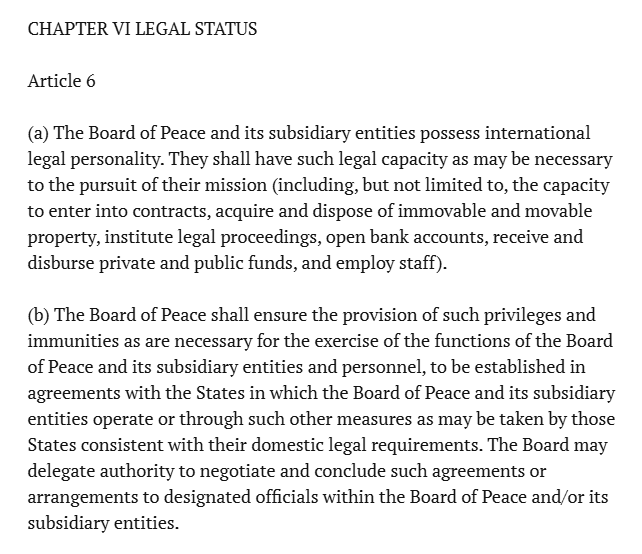
The key point is: it is built to behave like an international organization without being a UN organ.
4) The funding logic
Unlike the UN, the BoP does not rely on assessed contributions.

It relies on:
- Voluntary funding
- Reconstruction pledges
- Blended public-private capital
- Security commitments tied to stabilization
And one clause is unusually clear: large financial contributors gain extended governance positioning and influence.
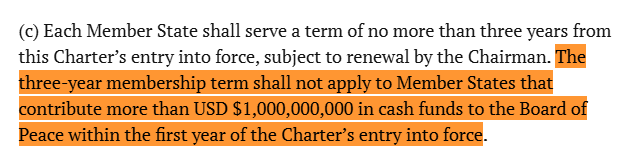
Money extends one's place inside the system. The more you give, the better positioned you are.
5) Membership: formally States, practically hybrid
Formally, only states can be members of the main Board.
Membership is by invitation only and member states are represented by heads of state or government. There are also: non-voting state participants and possible participation of regional integration organizations.
So on paper: it is a state-based body. But... on the operational layer it is hybrid.
The Executive Board and advisory structures include high-profile individuals drawn from political and financial elites. Names associated publicly include figures such as:
- Tony Blair - Tony Blair Institute for Global Change, providing government advisory and policy reform networks across multiple regions
- Jared Kushner - Affinity Partners, a private investment firm with significant Gulf sovereign fund backing and Middle East ties,
- Ajay Banga - current president of the World Bank Group providing multilateral development finance and sovereign lending architecture,
- Marc Rowan - CEO of Apollo Global Management, a large-scale private equity firm managing billions,
- Steve Witkoff - Witkoff Group with international real estate investment ties and transactional capital networks,
This creates a dual structure: state membership at the top, transnational elites in execution.
6) The role of private networks and companies
They bring to the table capabilities that are shaping outcomes in post-conflict environments: reconstruction contracts, concessions, and infrastructure management define the real power map.
Is the Board of Peace an alternative to the UN?
Once you strip away the media clickbait narrative and the political branding, the Board of Peace appears as a coordination device oriented towards action.
A device designed for a world where:
- multilateral legitimacy is slow,
- crises are capital-intensive,
- sovereignty is negotiable,
- and execution matters more than consensus.
It does not formally replace the United Nations. It operates alongside it but it functions differently. Traditional institutions assume: