

This week, a story began circulating. It is being treated, by most analysts and media outlets, as propaganda.
According to the story, a Venezuelan security guard loyal to Maduro described what he claimed to have witnessed during the US operation that led to Maduro's capture.
He says that without warning, Venezuelan radar systems went dark. Seconds later, large numbers of drones appeared overhead. Then a small number of helicopters inserted a limited group of US soldiers, perhaps 20 in total.
Against hundreds of guards, these men were described as operating with extreme speed and precision. The guard claims they were firing at a rate that made resistance impossible.
But the most striking part of the story comes next.
The guard says an unknown device was used, something he could only describe as a powerful sound or energy wave. He reports sudden, intense pressure inside the head, followed by nosebleeds, vomiting blood, and loss of motor control among those exposed.
According to this report, entire defensive units collapsed on the ground, unable to stand, while the attackers continued unimpeded.
In his telling, those twenty men suffered no casualties. Hundreds of Venezuelan guards were neutralized.
The account ends with a warning: that no one in the region should ever consider confronting the United States again and that what happened in Caracas will change how Latin America calculates risk.
There is no independent verification or technical confirmation, no forensic evidence.
Under normal standards, this would have remained just another battlefield rumor.
But it didn't.
The story was publicly relayed by Karoline Leavitt, the White House Press Secretary, through her official X account (@PressSec).
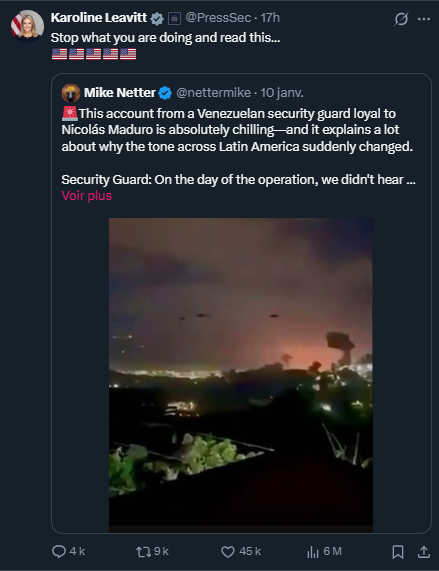
And that single act matters far more than the story itself.
Strategic ambiguity as a resource
The US government has not confirmed the existence of such a weapon. It has not denied it. It has not corrected the story.
It simply allowed it to circulate, and amplified it.