

A few days ago, a friend sent me the written speech of Ben Shapiro.
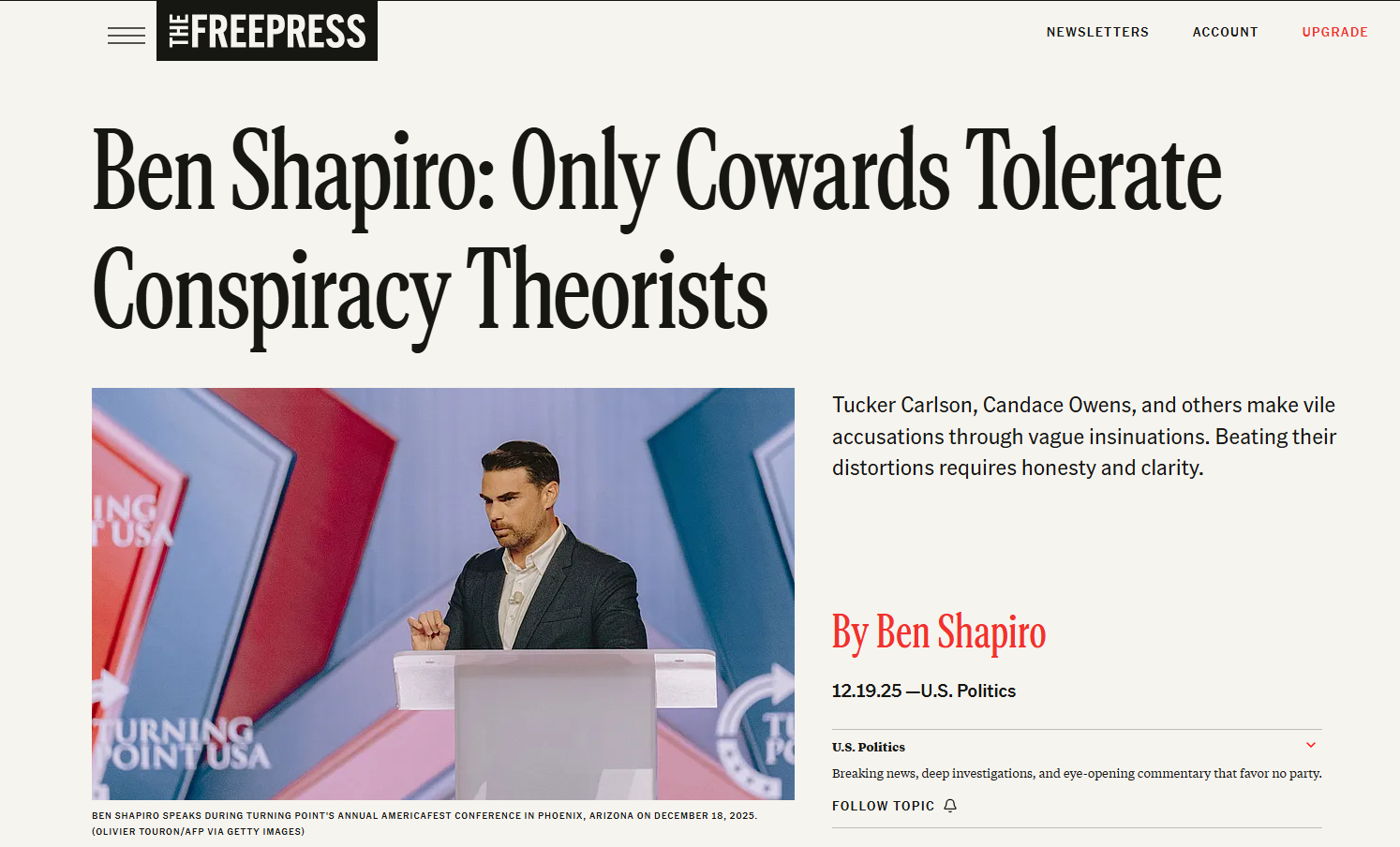
The title is quite explicit. And when someone as articulate and influential as Shapiro chooses this framing, it signals something deeper than a disagreement about facts.
It reveals how institutions (and those who speak in their name) are trying to deal with a phenomenon they no longer fully understand.
His argument seems reasonable. Conspiracy narratives can be destructive. They can distort reality, erode trust, and foster paralysis.
But the problem is not the diagnosis, it is the treatment. Shapiro approaches conspiracy thinking as a MORAL FAILURE.
I think this approach is fundamentally mistaken.
Conspiracy theories are not primarily a moral problem. They are a structural response to an opaque world.
Treating them as cowardice does not resolve that opacity. It deepens it.
What Shapiro fail to mention is that conspiracy thinking is born from a lack of legible structures. From the growing gap between visible consequences and invisible mechanisms.
You cannot moralize your way out of an ontological problem! That realization is what led me, over the years, to address the space they point to but fail to describe.
To understand why conspiracy narratives emerge, one must stop asking what people believe and start asking what kind of world they are trying to read.
TL;DR
- A personal note on why I got interested in the mechanisms behind conspiracies
- The false premise: that conspiracy thinking is about falsehood
- Why moral condemnation of conspiracies fails
- The real error of conspiracies
- The only strategy that consistently works to face conspiracy thinking, and neutralize it... gently.
A personal note
I was young the first time I encountered conspiracy theories. Too young, really to understand politics, history, or power. And yet, children my age already believed, with absolute certainty, in vast Jewish conspiracies.
I remember the dissonance clearly.
On one side, their fascination with an imagined Jewish power.
On the other, my own lived reality: a community that is not centralized, not unified, not coordinated, a people bound by history, memory, argument, disagreement but not by command or structure.
I was a kid. Kids ask "why?". Why were they thinking what they were thinking?
Later, when I grew up I realized these same kids, now adults, were obsessed with an image that has been taught to them, but INCAPABLE of following their own logic to its conclusion.
They sensed a pattern but had no understanding of what they were pointing at.
Later, when I was a student at Sciences Po, I encountered a different, far rarer form of toxic and conspiratorial thinking: the conspiracism of elites.
People who could read books, who knew dates, names, references, who repeated theories with confidence. And yet, who were fundamentally unable to connect them... Unable to read patterns, unable to distinguish structure from story.
Then you know the story, I became a journalist, and later, I moved into intelligence. That is when I entered the "backstage".
And in the backstage, I saw things that many would casually label "conspiracies." What struck me was... their banality.
In one specific case that comes to mind, the gap between the media narrative and reality was enormous. And the reality itself was painfully simple! I can't obviously share that case but I can say: it was just the boring story of two men that made human mistakes... Then entangled into a fragmented and administrative mess. No grand plan or hidden hand.
The story, as it truly happened (and I knew personally the two main actors of the "conspiracy") would have interested no one. Not even me.
The "conspiracy" related by the medias, on the other hand, was dramatic !
People preferred the fiction, not because it was true, but because it makes a good story. And in the context of medias, it sells better too, but that's another topic.
That was the moment I understood the real problem: reality, as it is structured today, is profoundly unsatisfying to explain.
I understood very early that "fighting conspiracy theories" is a pointless struggle. You don't fight conspiracies with facts and truth.
What I wanted was to go to the root of the phenomenon: the space between visible effects and invisible structures.
The false premise: that conspiracy thinking is about falsehood
It's not primarly about believing false things. It's more about trying to explain effects that appear without visible causes.
Modern power rarely presents itself openly. It operates through layers: legal, bureaucratic, economic, informational, technological. Actions are fragmented, responsibilities dispersed, decisions mediated by systems rather than individuals.
Decisions with massive consequences are made:
- without clear authorship,
- without explicit responsibility,
- without linear causality.
This creates a structural problem: effects without visible causes.
And human cognition does not tolerate causal voids for long... When formal explanations fail to map onto lived reality, people compensate.
Conspiracy narratives are therefore not born from ignorance alone, but from unresolved discrepancies between experience and explanation.
Even the most visible figures of our era, the ones we instinctively associate with power, can we genuinely say they are responsible for what is unfolding today?
In democratic systems, representatives govern for limited periods, within inherited frameworks and under constraints they did not design. The effects of their decisions rarely appear during their mandate. They emerge later, as policies compound, interact, and collide with other forces.
What we experience in the present is therefore less the product of a single will than the accumulation of layered decisions distributed across time.
In that context, authorship becomes structurally untraceable. And when architecture is invisible, fiction rushes in to fill the gap.
The Grey Zone as a condition
Much of today's power operates in the Grey Zone. In this space:
- influence exists without clear signature,
- actions remain below formal thresholds,
- responsibility is diluted across institutions and processes.
This requires no hidden masterminds or secret coordination. It emerges naturally from complex systems interacting under constraints.
When the Grey Zone is not acknowledged as a structural condition, it is filled with speculation.
Why moral condemnation fails
The problem lies in how conspiracy narratives are usually addressed:
“This is dangerous.”
“This is irresponsible.”
“This undermines trust.”
But labeling with moral condemnation does not restore trust. Actually it makes it worse.
Because when certain questions are delegitimized rather than answered, the implicit message is not "you are wrong" but "this area is off-limits."
And this has two predictable effects:
- It validates the intuition that something is being "hidden/protected".
- It drives inquiry underground, where it becomes more radical, not less.
Censorship or moral politice does not eliminate alternative narratives. They push them toward simpler, more mythological forms.
The real error of conspiracies
Conspiracy narratives do not fail because they suspect power. Power asymmetries are real. They fail because they misidentify how power operates.
They assume:
- centralized intent,
- coherent orchestration,
- unified control.
In other words, they personalize what is in fact systemic.
Most contemporary power does not function through "secret councils" or omnipotent actors. It functions through:
- incentive structures,
- institutional inertia,
- feedback loops,
- legal and technical complexity,
- diffusion of responsibility.
Replacing "hidden actors" with "hidden structures" changes everything.
The map-territory problem
What I find quite fascinating, is that both official/institutional narratives and conspiracy narratives suffer from the same flaw !
They simplify.
Institutions simplify reality to preserve legitimacy.
Conspiracy narratives simplify reality to restore coherence.
But at the end of the day, both offer maps that no longer match the terrain.
The Grey Zone is where that mismatch becomes visible. Ignoring this space produces denial and, eventually, loss of power. Mythologizing it produces conspiracy.
For institutions, refusing to acknowledge the Grey Zone is a form of mortality denial.
It is the belief that power can be stabilized indefinitely through administration and that complexity can be contained by procedure.
But power does not remain concentrated in the hands of administrators.
When institutions cling to the fiction of permanence, power migrates into informal spaces and parallel structures.
Institutions that refuse to recognize their own limits do not preserve power. They accelerate its escape. And the longer that space remains unnamed and unexamined, the more it will be filled either by denial from above, or by myth from below.
Why "just asking questions" is not enough
Questioning is important. In opaque systems, it is even necessary. But questioning is not a substitute for modeling.
Endless suspicion without giving structural articulation produces loss og agency, suspicion, paralysis and paranoia. At that point, what looks like critical thinking becomes a closed loop.
The only strategy I have seen consistently work.
Over the past decade studying this phenomenon, I developed and tested a method.
A warning though: this method I'm about to share disarms easily conspirationnists yes, but it also disarms binary institutionalists.
This method is inspired from my years in the field. It's a HUMINT approach to elicitation and influence, in 4 steps: