


I will not be analyzing the document as a "national security strategy". Instead, I'll treat it as what it truly is: an act of secession from the international order.
My approach draws on two analytical frameworks I've developed for reading geopolitics: the Grey Zone (which maps what systems reveal through their silences and contradictions) and the Quantum Framework (which examines how perception operates across multiple levels simultaneously).
In simple terms, I dissect. I reveal what the text says explicitly, what it says implicitly, and above all: what it cannot say but which structures its entire architecture.
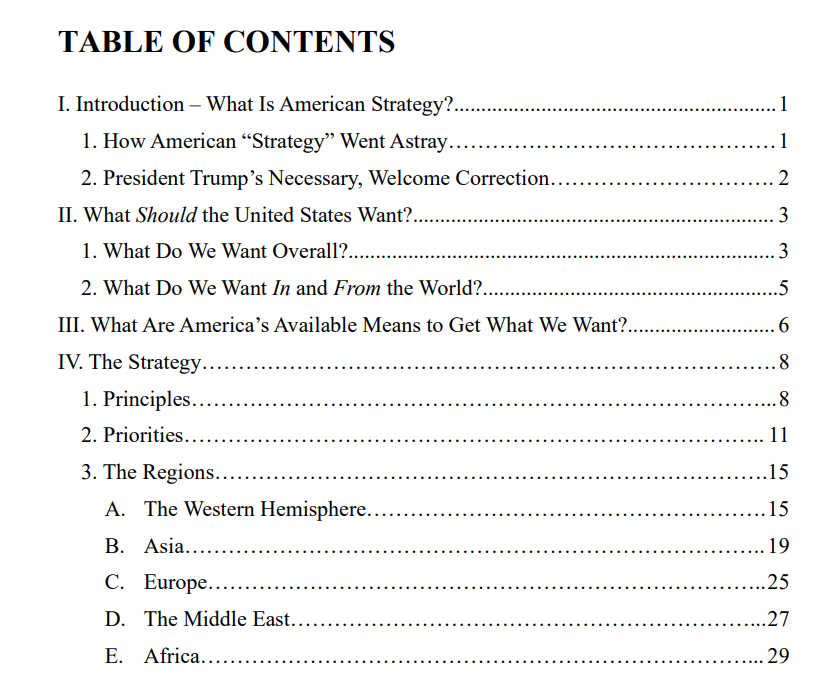
1) The opening diagnosis
2) The redefinition of "national security"
3) The Monroe Doctrine 2.0 (The Trump Corollary)
4) The strategic omission of China
5) Europe as a patient... not a partner.
6) What the document DOESN'T say
7) The principles
8) The priorities
9) Economy as war infrastructure
10) What the STRUCTURE of the document reveals
11) Conclusions
1) The opening diagnosis: "American strategy went astray"
The document opens with an unequivocal diagnosis:
"American strategies since the end of the Cold War have fallen short—they have been laundry lists of wishes or desired end states; have not clearly defined what we want but instead stated vague platitudes; and have often misjudged what we should want."
This sentence is a principled invalidation of 30 years of American foreign policy. Bush, Clinton, Bush Jr, Obama, Biden: all are implicitly designated as having pursued erroneous objectives.
The central accusation: "elite" betrayal
"After the end of the Cold War, American foreign policy elites convinced themselves that permanent American domination of the entire world was in the best interests of our country. Yet the affairs of other countries are our concern only if their activities directly threaten our interests."
Here, the text inverts the burden of proof. It is not Trump who must justify his break with the Atlanticist consensus, it is the "elites" who must answer for their betrayal.
The 5 cardinal errors
The document identifies five failures of previous administrations:
"They miscalculated America's willingness to shoulder forever global burdens to which the American people saw no connection to the national interest."
Translation: The American people NEVER CONSENTED to empire. Global hegemony was an elite project, not a national one.
"They overestimated America's ability to fund, simultaneously, a massive welfare-regulatory-administrative state alongside a massive military, diplomatic, intelligence, and foreign aid complex."
Translation: The welfare state and empire are incompatible. A choice must be made.
"They placed hugely misguided and destructive bets on globalism and so-called 'free trade' that hollowed out the very middle class and industrial base on which American economic and military preeminence depend."
Translation: Free trade destroyed the material foundation of American power. Globalization was strategic suicide.
"They allowed allies and partners to offload the cost of their defense onto the American people, and sometimes to suck us into conflicts and controversies central to their interests but peripheral or irrelevant to our own."
Translation: Allies are parasites. They exploited American generosity.
"They lashed American policy to a network of international institutions, some of which are driven by outright anti-Americanism and many by a transnationalism that explicitly seeks to dissolve individual state sovereignty."
Translation: Multilateral institutions are not neutral. They are enemies of sovereignty.
2) The redefinition of "national security"
The section "What Should the United States Want?" operates a radical shift. Traditionally, American national security was defined by:
- The capacity to project power
- Nuclear deterrence
- Control of the seas
- Maintenance of a favorable international order
The 2025 document redefines security as:
"We want full control over our borders, over our immigration system, and over transportation networks through which people come into our country—legally and illegally."
"We want a resilient national infrastructure that can withstand natural disasters, resist and thwart foreign threats, and prevent or mitigate any events that might harm the American people or disrupt the American economy."
"We want the world's most robust industrial base. American national power depends on a strong industrial sector capable of meeting both peacetime and wartime production demands."
Security is no longer the capacity to act in the world, but the capacity to no longer depend on the world.
The inclusion of the civilizational dimension
The document crosses an unprecedented threshold:
"Finally, we want the restoration and reinvigoration of American spiritual and cultural health, without which long-term security is impossible. We want an America that cherishes its past glories and its heroes, and that looks forward to a new golden age. We want a people who are proud, happy, and optimistic that they will leave their country to the next generation better than they found it."
"This cannot be accomplished without growing numbers of strong, traditional families that raise healthy children."
"Cultural health," "spiritual restoration," "traditional families" become official components of national security.
This is unprecedented in the history of American NSS documents.
The boundary between foreign policy and domestic policy is abolished. National security is no longer solely a matter of external threats; it includes internal identity cohesion. This is ontological security (6th dimension of the Quantum Framework).
3) The Monroe Doctrine 2.0 (the Trump Corollary)
The Monroe Doctrine (1823) stated that the Western Hemisphere was closed to European colonization. The "Trump Corollary" goes further: any extra-hemispheric presence is now considered a threat.
"After years of neglect, the United States will reassert and enforce the Monroe Doctrine to restore American preeminence in the Western Hemisphere, and to protect our homeland and our access to key geographies throughout the region. We will deny non-Hemispheric competitors the ability to position forces or other threatening capabilities, or to own or control strategically vital assets, in our Hemisphere."
The vocabulary of occupation
"The United States must reconsider our military presence in the Western Hemisphere."
The text expands and uses military vocabulary: "control," "secure," "defeat," "lethal force." The Western Hemisphere is no longer a zone of diplomatic influence. It IS a theater of operations.
The economic instrumentalization of the neighborhood
"The terms of our alliances, and the terms upon which we provide any kind of aid, must be contingent on winding down adversarial outside influence—from control of military installations, ports, and key infrastructure to the purchase of strategic assets broadly defined."
"The terms of our agreements, especially with those countries that depend on us most and therefore over which we have the most leverage, must be sole-source contracts for our companies."
Latin American countries are no longer partners. They are zones of economic extraction and security glacis.
4) The strategic omission of China
The document devotes an entire section to Asia, but China is never named as a systemic adversary in the general principles. In the "Asia" section, the tone is one of manageable economic competition, not existential conflict:
"President Trump single-handedly reversed more than three decades of mistaken American assumptions about China: namely, that by opening our markets to China, encouraging American business to invest in China, and outsourcing our manufacturing to China, we would facilitate China's entry into the so-called 'rules-based international order.' This did not happen. China got rich and powerful, and used its wealth and power to its considerable advantage."
Notice: there is no moral condemnation. No accusation of "existential threat." Only an observation: China played its game, the United States played theirs poorly.
Absolute priority: avoid war
"This must be accompanied by a robust and ongoing focus on deterrence to prevent war in the Indo-Pacific. This combined approach can become a virtuous cycle as strong American deterrence opens up space for more disciplined economic action, while more disciplined economic action leads to greater American resources to sustain deterrence in the long term."
The objective is not to "defeat" China, nor even to "contain" it. The objective is to reduce economic dependence while avoiding military conflict.
Taiwan: maintained ambiguity
"We will also maintain our longstanding declaratory policy on Taiwan, meaning that the United States does not support any unilateral change to the status quo in the Taiwan Strait."
This sentence deserves attention. The document does not say "the United States will defend Taiwan." It says: "the United States does not support any unilateral change."
This leaves open the possibility of a negotiated change.
5) Europe as a patient... not a partner.
The diagnosis is tough: "civilizational erasure"
"American officials have become used to thinking about European problems in terms of insufficient military spending and economic stagnation. There is truth to this, but Europe's real problems are even deeper."
"This economic decline is eclipsed by the real and more stark prospect of civilizational erasure. The larger issues facing Europe include activities of the European Union and other transnational bodies that undermine political liberty and sovereignty, migration policies that are transforming the continent and creating strife, censorship of free speech and suppression of political opposition, cratering birthrates, and loss of national identities and self-confidence."
"Should present trends continue, the continent will be unrecognizable in 20 years or less."
The tone is not that of a partner offering advice. It is that of a physician announcing a fatal prognosis...
Assumed interference
"American diplomacy should continue to stand up for genuine democracy, freedom of expression, and unapologetic celebrations of European nations' individual character and history. America encourages its political allies in Europe to promote this revival of spirit, and the growing influence of patriotic European parties indeed gives cause for great optimism."
"Our broad policy for Europe should prioritize: [...] Cultivating resistance to Europe's current trajectory within European nations."
The United States explicitly announces that it will support political forces opposing governments in power.
This is exactly what the United States accused Russia of doing.
The demographic question as strategic threat
"Over the long term, it is more than plausible that within a few decades at the latest, certain NATO members will become majority non-European. As such, it is an open question whether they will view their place in the world, or their alliance with the United States, in the same way as those who signed the NATO charter."
This sentence is of rare conceptual violence. It states: if the ethnic composition of the European population changes, NATO could lose its raison d'être.
6) What the document DOESN'T say
This is where it gets even more interesting.