


The year has barely started... It was Saturday.
The kind of day where systems are supposed to be dormant. Embassies and institutions are in "weekend mode", diplomatic channels are quiet, markets are thin.
Exactly when friction is low.
Yet, overnight, the United States struck Venezuela. By morning, the world wakes up to fragments: explosions, a captured president, conflicting narratives...
During the day, a press conference that feels less like an explanation than a declaration.

Most people don't understand what just happened.
This brief analyzes what was said, what was done, and what systems responded... or failed to.
What happened in Venezuela on January 3rd doesn't need approval or condemnation to be understood. This piece analyzes how power operates when the systems designed to constrain it cease to function in real time.
If you're looking for someone to tell you what to think, stop here.
If you want to understand what actually happened, keep reading.
TL;DR
1) What happened
2) What the press conference revealed
3) The tactical detailed disclosed
4) About the language: the dual grammar of the operation
5) Oil is not subtext, it is the point
6) The return of the Monroe Doctrine
7) International law: not violated, just bypassed
8) The Venezuelan interior: the decisive unknown
9) The battle for meaning: conspiracies, ideology, and moral framing
10) Implications beyond Venezuela
11) What to watch next (real indicators)
Conclusion
1) What happened
In the early hours of January 3, US forces conducted a direct military operation on Venezuelan soil.
- Nicolas Maduro and his wife were allegedly captured alive and extracted.
- The operation involved air, ground, maritime, and unmanned assets, with reported strikes on military and logistical sites around Caracas.
- Electrical outages and temporary paralysis of Venezuelan command-and-control systems were observed.
- The operation was publicly claimed by Donald Trump within hours on his social media.
- No coalition was involved.
- No UN mandate was sought.
- No declaration of war was issued.
The official justification emphasized criminal indictments, drug trafficking, and justice, framing the action as law enforcement rather than interstate conflict.
But the press conference altered the nature of the event, and made it even more interesting...
2) What the press conference revealed
Until the press conference, we could plausibly describe the operation as:
- a high-value target capture,
- a decapitation strike,
- a unilateral but limited action.
But that interpretation does not survive the statements of POTUS and his team. During the conference, Donald Trump stated, repeatedly and unambiguously:
"We're going to run the country."
"We're going to stay until a proper transition takes place."
"We can't take a chance on someone else taking over."
"We are prepared for a second wave, a much bigger wave."
We can't say it isn't explicit.
What was initially framed as a capture is now described as temporary governance and direct control.
And deterrence comes from the explicit readiness to escalate.
3) The tactical detailed disclosed, and what this selective transparency tells us about power
Contrary to expectations, the US did not maintain total operational opacity. Instead, it released just enough tactical details to shape perception:
- The operation had a name: "Absolute Resolve".
- A precise time of contact was mentioned.
- More than 150 aircraft were involved, launched from multiple bases, both land- and sea-based.
- Platforms referenced included F-22s, F-35s, F-18s, B-1 bombers, drones, and airborne command-and-control assets.
- Cyber and space components were activated as part of the operation.
- Helicopters came under fire during the insertion phase.
- One aircraft was hit, but remained flyable.
- Unmanned systems and overhead aviation provided continuous coverage.
- Extraction was completed within a clearly defined time window, with forces recovering to a U.S. naval platform.
- No U.S. personnel were killed.
- Not one piece of equipment was lost.
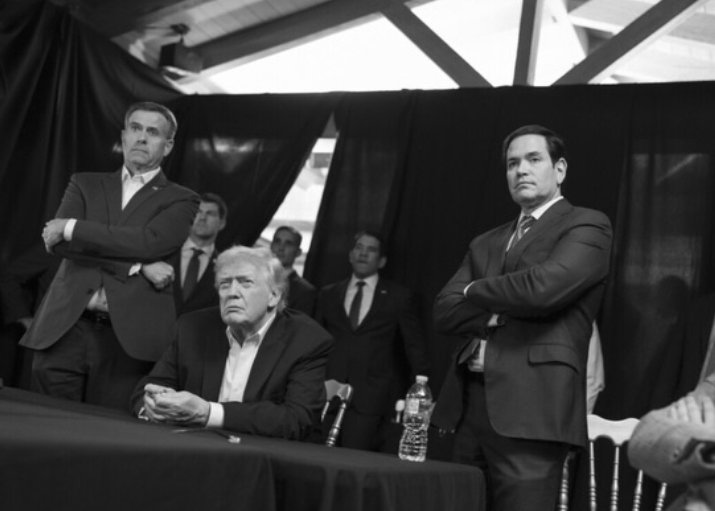
At a certain point during the conference, Trump is not reading the script. It feels more like he's giving a personal commentary on the speech. He says:
"It was dark... The lights of Caracas were largely turned off due to a certain... expertise that we have. It was dark... and it was deadly."
He's giving us some tactical and operational details (with pride). And this is important.
It confirms the deliberate use of darkness and blackout conditions, the control of the electromagnetic and urban environment, and the sequencing of effects prior to physical insertion.
The conference also indicates that Venezuelan defenses were engaged, not absent. The operation proceeded under fire, without interruption.
What emerges from these details is an operation largely thought, built, prepared deliberately layered accross air, maritime, ground, cyber, space, and intelligence.
The sole capture of an individual could have been more surgical, discreet, like a minimal raid style. But it was chosen to proceed otherwise.
They said it themselves, it was a demonstration.
It was about demonstrating the ability to control the entire operational environment, sustain dominance under resistance, and escalate if required, without friction, delay, or visible cost.
The message is: "We can do this, cleanly, repeatedly, and without cost."
4) About the language: the dual grammar of the operation
The press conference operated in two distinct linguistic registers used simultaneously.
1. The judicial register
This register frames Maduro as an individual criminal, subject to indictment, destined for trial, removed from the category of sovereign actor.
Its function is to depoliticize the strike, reduce it to procedure, and neutralize the concept of aggression against a state.
2. The commerce/resource/security register
From start to finish, the language repeatedly returns to the same pillars: money, production, extraction, repayment, business, and strategic control.
The vocabulary shifts away from ideology and toward capacity and economics.
"we will run the country"
"American companies"
"fix the oil infrastructure"
"start making money"
"it will pay for itself"
"we’re prepared for a second wave"
"dark and deadly"
The language is:
- sensory when describing force,
- economic when describing purpose,
- and managerial when describing duration.
It is meant to signal capability and intent. To allies, competitors and markets alike.
Understanding this is crucial, because it reveals the true hierarchy of priorities: law frames the action, but commerce and resource control structure it!
These two registers are complementary.
The real message is found in which language is used for which audience.
5) Oil is not subtext, it is the point.
While the world speculates, while analysts chase hidden motives, while social media spins theories about secret deals and shadow agendas... the central logic is not concealed. At all.