


You know I tend to be quite critical of media and journalism. Having worked in the field, I know how narratives are built, simplified, distorted.
Because of that, I refuse many interview requests.
Yet, when Lider, a Croatian business magazine, reached out, I said yes. And the reason is simple: in the Balkans - and in Croatia specifically - people instinctively understand the Grey Zone.
Some regions of the world experience instability as an abstract concept...
Others have lived inside it, and still do.
The Balkans belong to the second category.
Last December, while walking through Zagreb with a Croatian historian, we discussed Yugoslavia: a state that tried to compress different peoples into a single political structure.
It held together for decades, until the moment pressure loosened and the system split along the very lines it tried to erase.
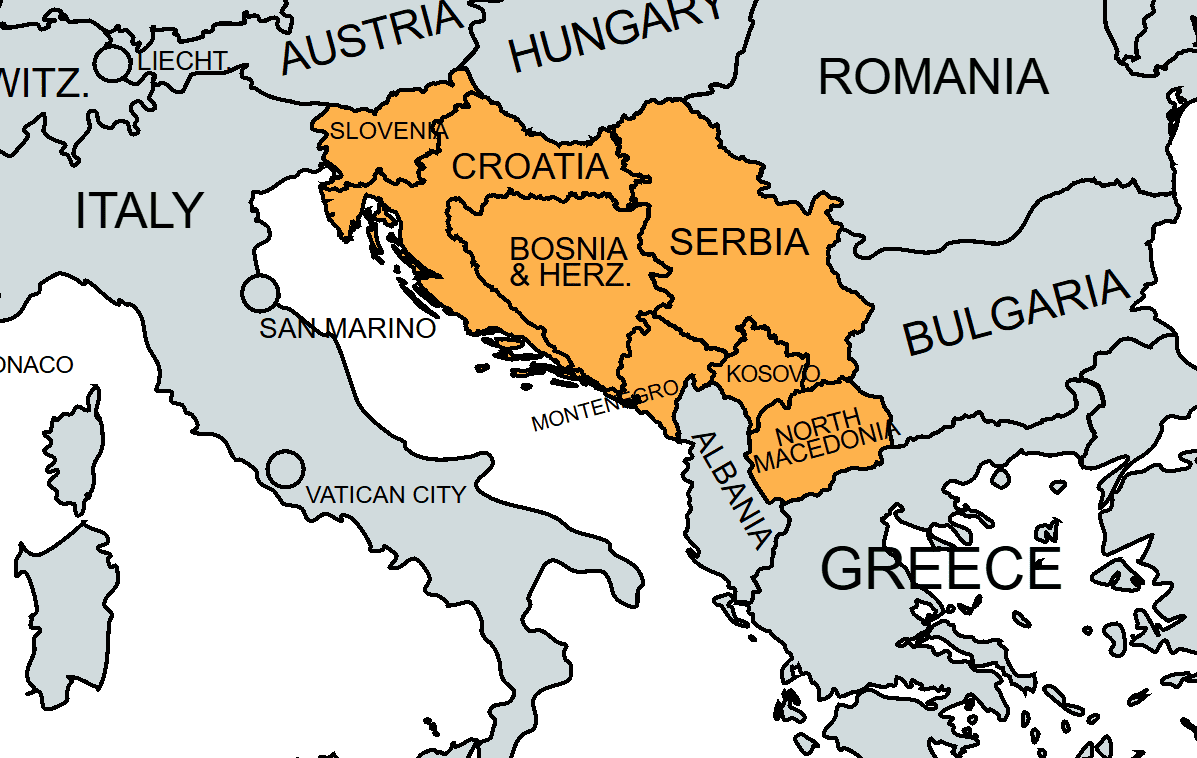
Borders have shifted repeatedly in this region. Alliances have reversed. Entire systems have collapsed and been rebuilt within a single generation.
When you speak with people from the Balkans, you notice something particular, and I personally very much appreciate: a kind of embodied awareness of history.
They understand history isn't linear. For them, instability is memory, not theory and that... produces a very different way of reading the world.
There is something strategically fascinating about small exposed states.
They understand the world better than larger powers. Why? Because their survival depends on reading signals correctly.
Think about it: when you cannot rely on military scale or economic dominance, you learn to survive... differently. You observe shifts earliern, the changes in alliances, the narratives movements, and shifts in power balances. You learn to pay attention to signals others dismiss.
In other words: you learn to read structure before events. And this is precisely the terrain of the Grey Zone.
The Balkans have long functioned as a geopolitical intersection point.
Empires, alliances, and political systems have overlapped here for centuries. Today the region still sits at the intersection of several spheres of influence - European, Russian, Turkish, and increasingly Chinese.
No single power fully dominates the landscape.
Which means actors must constantly navigate ambiguity. In such environments, survival depends less on strength than on perception.
Leaders and entrepreneurs in these regions know that systems can shift quickly. Alliances can reverse. Crises rarely appear without warning signals.
Their experience forces them to think structurally.
In that sense, the Balkans function almost like a living laboratory of the Grey Zone.
Many of the dynamics analysts now observe elsewhere in the world (hybrid conflicts, competing narratives, fragmented authority, overlapping spheres of influence) have been part of the political reality of the region for decades.
And this may be the deeper lesson...The rest of the world is slowly becoming more like the Balkans: fragmentation, fluid alliances, competing powers, and permanent ambiguity.
The Grey Zone is the normal condition of global politics. This is why speaking to a Croatian audience felt like continuing a conversation with people who already recognize the patterns of the Grey Zone.
The interview is available here (in Croatian).
Stay lucid,
Oriane