


In December 1959, a French magazine published an article with a wonderfully Cold War title: "Thought Transmission: A Weapon of War."
The author, Jacques Bergier, claimed that the United States had successfully tested telepathic communication with the nuclear submarine USS Nautilus. Two months later, Science et Vie put a submarine on its cover beneath another irresistible headline: "Étrange expérience à bord du Nautilus."

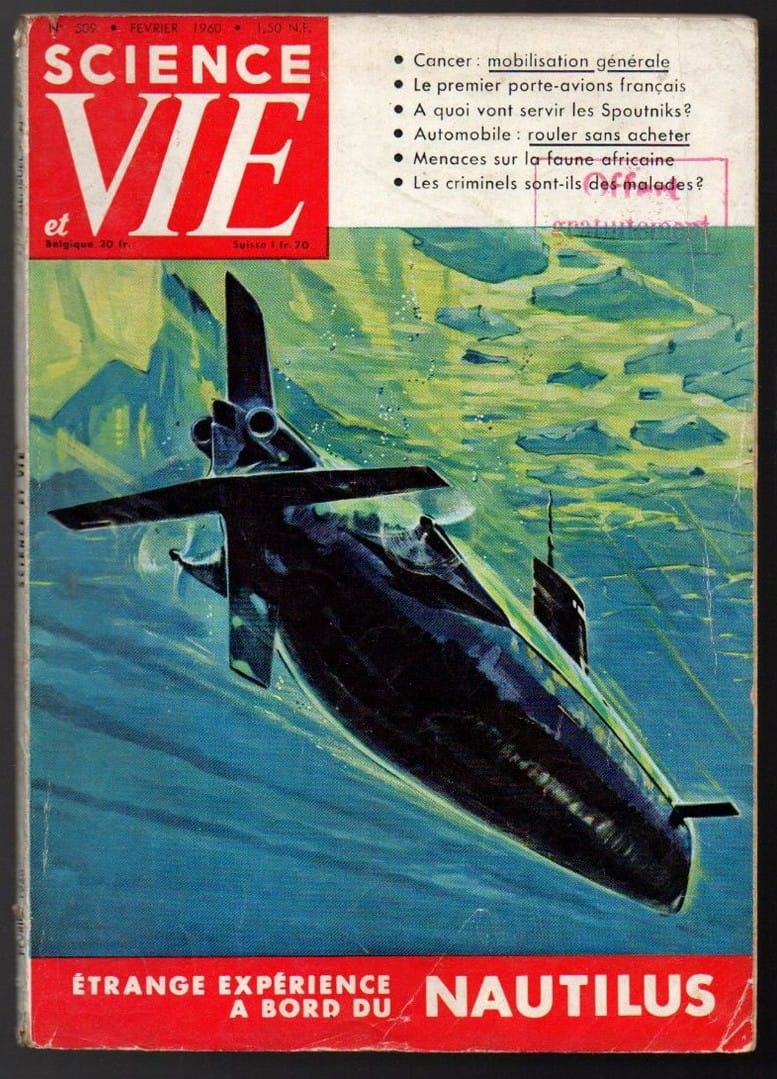
Constellation n°140 (1959), Science et Vie n°509 (1960)
The story travelled east. Moscow paid attention.
The United States denied that the experiment had ever taken place. But in the Soviet Union, it became the subject of serious discussion. Soviet scientists were asked whether telepathy might actually be possible.
Leonid Vasiliev had worked on "mental suggestion" with neurologist Vladimir Bekhterev as early as the 1920s and later became professor of physiology at Leningrad University.
The Nautilus controversy helped bring that older line of research back into public and institutional view. In 1960, Vasiliev argued that Soviet scientists should overcome their prejudice against telepathy and resume serious investigation. Around the same period, a dedicated laboratory for the study of "mental suggestion" and biocommunication began operating under his direction at Leningrad University.
Yes. You read that right.
A claim about an American capability (one the Americans themselves said did not exist) contributed to renewed Soviet interest in developing the said-capability.
Then American intelligence began studying Soviet research. By the 1970s and 1980s, US intelligence assessments were describing extensive Soviet work on what Soviet researchers preferred to call biocommunications, psychoenergetics or psychotronics: telepathy, remote perception, psychokinesis and other alleged anomalous phenomena.
One American assessment noted that some of this terminology gave the field an appearance of scientific or technological respectability.
Washington now faced a problem: what if the Soviets had found something?!
Even if the probability was low... that was a real and important question.
Intelligence services do not have the luxury of investigating only things they already know to be true. They also have to investigate possibilities whose consequences would be serious if they were true.
I have spent the first two articles in this series looking at the return of esoteric language around cognitive warfare, and at the environments and practices people use to deliberately alter consciousness. This last article moves somewhere else.
The question I am interested in is:
What happens institutionally when the adversary's supposed capability begins changing your behaviour before you have even established that the capability exists?
To answer that, I am going to explore the feedback loop of the Cold War itself: how claims, rumours, intelligence assessments and fear of technological surprise could generate real programs on both sides, regardless of whether the original phenomenon was ever operationally reliable.
Eventually, where should intelligence place intuition, anomaly and unexplained information inside its own hierarchy of truth.
Making the impossible legible
By the 1970s, American analysts were collecting Soviet publications and trying to determine what Moscow was doing with this strange field.
The uncertainty is visible in the documents themselves. A 1978 SRI report was literally titled Advanced Threat Technique Assessment. Its stated purpose was to determine whether "psychoenergetic processes" could constitute an advanced technology under development in the USSR. Those processes included mentally acquiring information supposedly inaccessible through ordinary perception and producing physical effects on protected equipment.
Another U.S. Air Force document from the same period says the objective was to "evaluate or simulate USSR research achievements (or claims)" and examine the feasibility of communication and remote viewing.
Achievements or claims.
Intelligence had to respond to both. If Moscow claims to possess something impossible, Washington has several bad options:
- Ignore it, and risk technological surprise.
- Believe it, and risk wasting resources chasing fiction.
- Investigate it, and risk converting the investigation into evidence that the phenomenon "must be" important.
The United States chose investigation.
What exactly were they trying to do
Before going any further, it is worth asking what "remote viewing" actually meant.
The second part of this brief is where I connect the pieces. Operators get it in full every week, along with 130+ pieces organised in ten dossiers.
€200 a year, less than €17 a month.
Or €20 monthly, cancel any time.