


Davos' annual meeting opens today.
World leaders, CEOs, and institutions will spend a few days talking about the future: AI, governance, energy, geopolitics, innovation... under the theme "A Spirit of Dialogue".

Prosperity.
That is the word Davos keeps using. Everything converges toward the same assumption: that prosperity will continue.
Prosperity, in its original sense, is about something that outlives those who benefit from it. A system that remains inhabitable after those in power are gone. A future that does not collapse once the present steps aside.
But there is a question no one there will ask:
Who is that future actually for?
Klaus Schwab is 87. He founded the World Economic Forum. Recently, he published two books about longevity and aging.
I read them carefully.
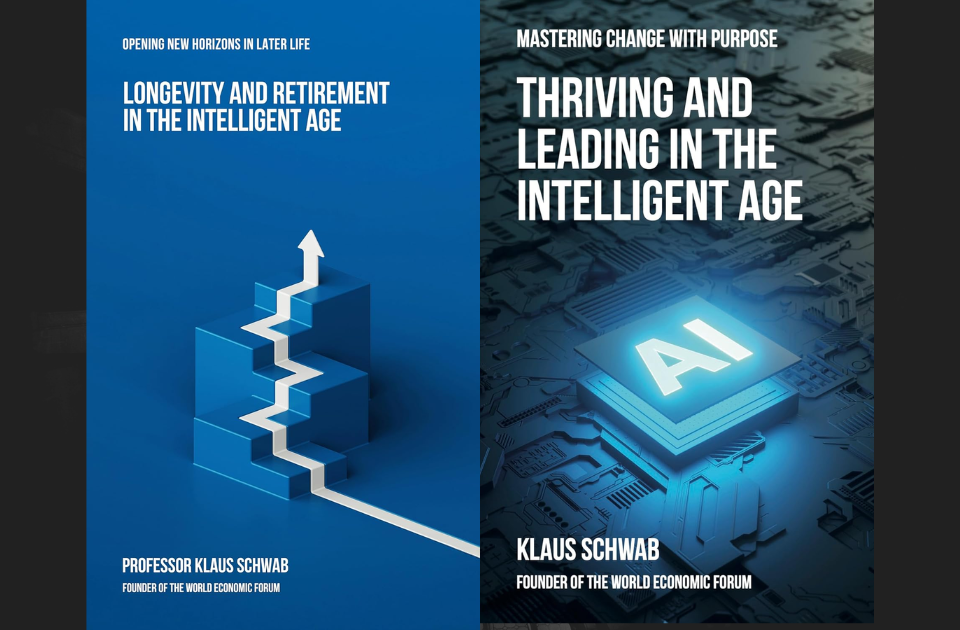
When someone like Schwab writes about aging, it is a window into how global elites think about their own longevity, relevance, and what they believe they're leaving behind.
His books are well-documented and articulated. Yet, they left me uneasy for a simple reason. There are two words that never appear:
Transmission.
Demographic collapse.
He writes about optimization, technology, social systems, how to stay relevant. He talks about "legacy" and "being remembered", but never about leaving. Never about those not yet born.
And this is a structural symptom.
Schwab stepped down as chair of the WEF in April 2025. But the pattern he embodies did not step down with him.
This piece is about a system that has lost the ability to hand itself over and transmit. And when transmission disappears, two things happen at once:
- power stops renewing,
- societies stop reproducing.
Ossification follows naturally.
The mechanism: how systems renew
A system normally renews itself in two ways:
- through new generations (biology),
- through succession (politics).
When those who should leave refuse to do so, both break.
The faces stay, the titles stay, the ceremonies stay. But decisions migrate: from Presidents to advisors, from ministers to staffers, from parliaments to platforms, from law to... code!
No one announces it, it just happens. Power starts leaking into whatever can still operate: informal networks, private systems, grey infrastructures - the interstices. This is the Grey Zone.
And the same mechanism exists in private life. When there is no future to enter, nothing gets transmitted. Not wealth, not meaning, not courage, not lineage. People do not reproduce when the future is opaque.
Population collapse doesn't look like collapse. It looks like continuity without renewal.
Why demographic decline changes war, governance, and strategy
States continue to function, institutions remain standing, budgets are voted, elections are held... but the future becomes increasingly thin.
Historically, kinetic power rested on simple foundations:
- a young population,
- bodies available for production and defense,
- a capacity for collective sacrifice.
Demographic decline makes that model politically and materially harder to sustain: frontal wars become too costly because societies cannot afford to lose their youth. With fewer young bodies available, war becomes less survivable as a public choice.
So war doesn't disappear, it changes form. It migrates toward influence, proxy systems, economic coercion, intelligence operations, narrative control... indirect power.
At the same time, an aging population behaves predictably: it votes to protect what it has. It avoids risk. It demands stability.
Not renewal. Renewal is too uncontrollable, too unpredictable.
Maybe just like the act of... having a child?
Some will claim immigration is the solution. Immigration can delay the visible effects of demographic collapse by replenishing the active base, but it does not solve the problem of transmission: it shifts population numbers without recreating a shared future.
The Grey Zone becomes visible in a world that no longer has enough children to fight openly.
What separates power from obsolescence in the 21st century is the capacity to generate a future.
Societies that can still create the conditions for transmission will shape the next century. Societies that cannot will manage their own decline, no matter how wealthy or technologically advanced they are.
Population collapse is not primarily about money
Take Scandinavian governments. They built some of the most generous family policies in the world, and still sit among the lowest fertility rates.
Even when housing, careers, and gender asymmetries are addressed, fertility barely recovers. Because the problem isn't only economic or political. It is ontological.
So the real question: what are we willing to transmit?
In one of his books, Schwab claims our societies are too "youth-centered".
This is very wrong.
Can we talk about a "youth-centered society" when we're not renewing the youth?
What I observe is the exact opposite. A cult of longevity but not of life itself. We want to stay longer, we want youth aesthetics. We want relevance, performance, extended productivity, and we build a world structurally uninhabitable for a child.
There is no symbolic space for a new life to enter.
Schwab writes about how to stay relevant at 87. But not about how to make space for those who are not yet born.
The societies that still reproduce
Some advanced societies escape demographic collapse.
Israel, for instance. Israel's fertility rate is around 2.9. Why? Because transmission is visible, ritualized, and unavoidable. Religion, national survival, military service, public culture... The future is staged daily.
But Israel is not unique.
Across the world, the societies that still reproduce tend to share one trait: a strong metaphysical structure of transmission. Sometimes religious. Sometimes tribal. Sometimes national. But always thicker than individual preference.
- Gulf states: 2.5-3 children. Islam as a framework of lineage and duty. Public life shows children being initiated, embedded in traditions: falconry, horsemanship, discipline, lineage.
- Sub-Saharan Africa: 4-6 children. Christianity, Islam, and tribal continuity.
Now look at the inverse:
- Western Europe and North America (outside religious communities): < 1.6-1.7
- East Asia (Japan, Korea, China, Taiwan, Singapore): < 1.3
Secularization is one of the strongest predictors of fertility decline, even when controlling for income, education, and urbanization.
Because reproduction does not respond to material incentives.
To have a child is to accept loss of control, irreversible exposure to the future, sacrifice without guarantee. No rational cost-benefit calculation justifies that. Family policies help those who already decided to reproduce. They do not create the desire.
That desire comes from a story that transcends the self. A story that says: "you are not living only for yourself". Whether religious, national, or tribal, it turns reproduction into participation in something that is "bigger than you".
Secular modernity offers us autonomy, comfort, self-optimization. But it offers no reason to give without return. No symbolic space where losing time, money, sleep, or identity is anything but... a failure.
A child is exactly that: a radical investment with no guaranteed return.
High-fertility societies aren't "better" models. They pay for reproduction with coercion, inequality, and violence. But they do reproduce. They understand a hard constraint modern societies try to deny, you cannot maximize:
- total individual autonomy AND
- full secularism AND
- complete equality AND
- maximal comfort AND
- demographic renewal.
Every society that still reproduces has relinquished at least one of these. Every society that refuses to give up any of them slowly disappears.
But one thing's for sure: at the end of the chain, transmission always rests on individual responsibility.