

I came across the letter published on X yesterday, written by Joe Kent - former U.S. Army Special Forces operator, with multiple deployments, now involved in national security and political circles in the United States.
He publicly announced his resignation from the National Counterterrorism Center.
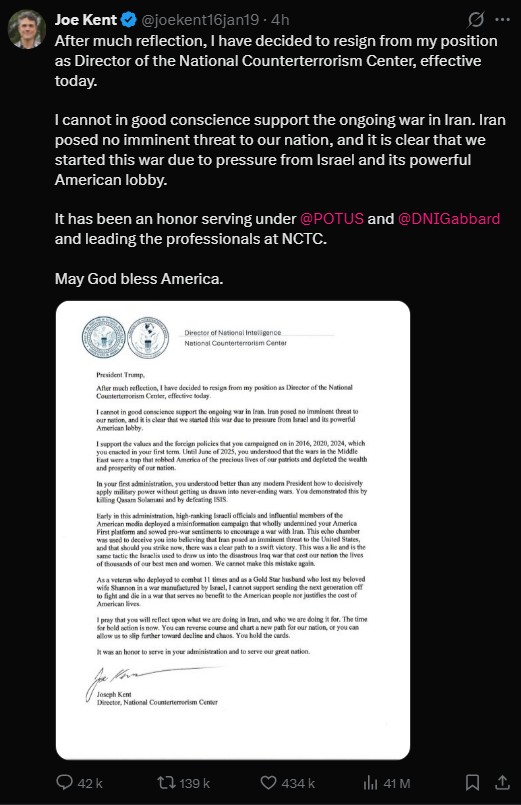
I read it once, then I read it again. Actually stopping to read one text a few times is rare nowadays.
I thought: "how fascinating".
If you know me, you know that when I say "fascinating", I mean "something here is dangerous".
In fact, this is one of the most effective Grey Zone objects I've seen in a while. A perfect hybrid document:
Part resignation.
Part moral confession.
Part narrative weapon.
Designed for one thing: give you a simple story, and push you to take a side.
Most people will read it and react: agree, disagree, get emotional, pick a camp. That's the trap.
So before you decide what you think, before you decide if this is "right or wrong", read what follows. Then you can choose: between lucidity or the comfort of choosing sides.
In what follows, I will :
- dissect the architecture of the letter and show how it is built to guide perception step by step,
- expose the Grey Zone mechanism: how it simplifies reality, assigns causality, and pushes you to choose a side before you even realize it.
- And finally, because the text is also clearly trying to capture Trump narratively, I will explain how he should have responded to this kind of maneuver.
Before we dissect the text, I'd like to remind you what Joe's job was. He was sitting at one of the points where intelligence is assembled.
The National Counterterrorism Center does not collect intelligence like the CIA, the FBI, the NSA or even the military. The NCTC receives intelligence and turns fragments into threat assessment for decision-makers, including the President of the United States.
The NCTC was created in 2004, in the aftermath of 9/11, to prevent one thing: fragmentation.
At that level, you don't deal with linear stories. You are supposed to deal with complex intelligence, uncertainty, competing interpretations and incomplete signals.
Most of the time, intelligence never reaches the public. Remember the triad, information only has 3 possible fates:
- If it's contained, it's transformed into intelligence, and serves decision.
- If it's leaked, it's a breach. It is rare, but it happens.
- Ifi it's made public, you're looking at a narrative, not intelligence.
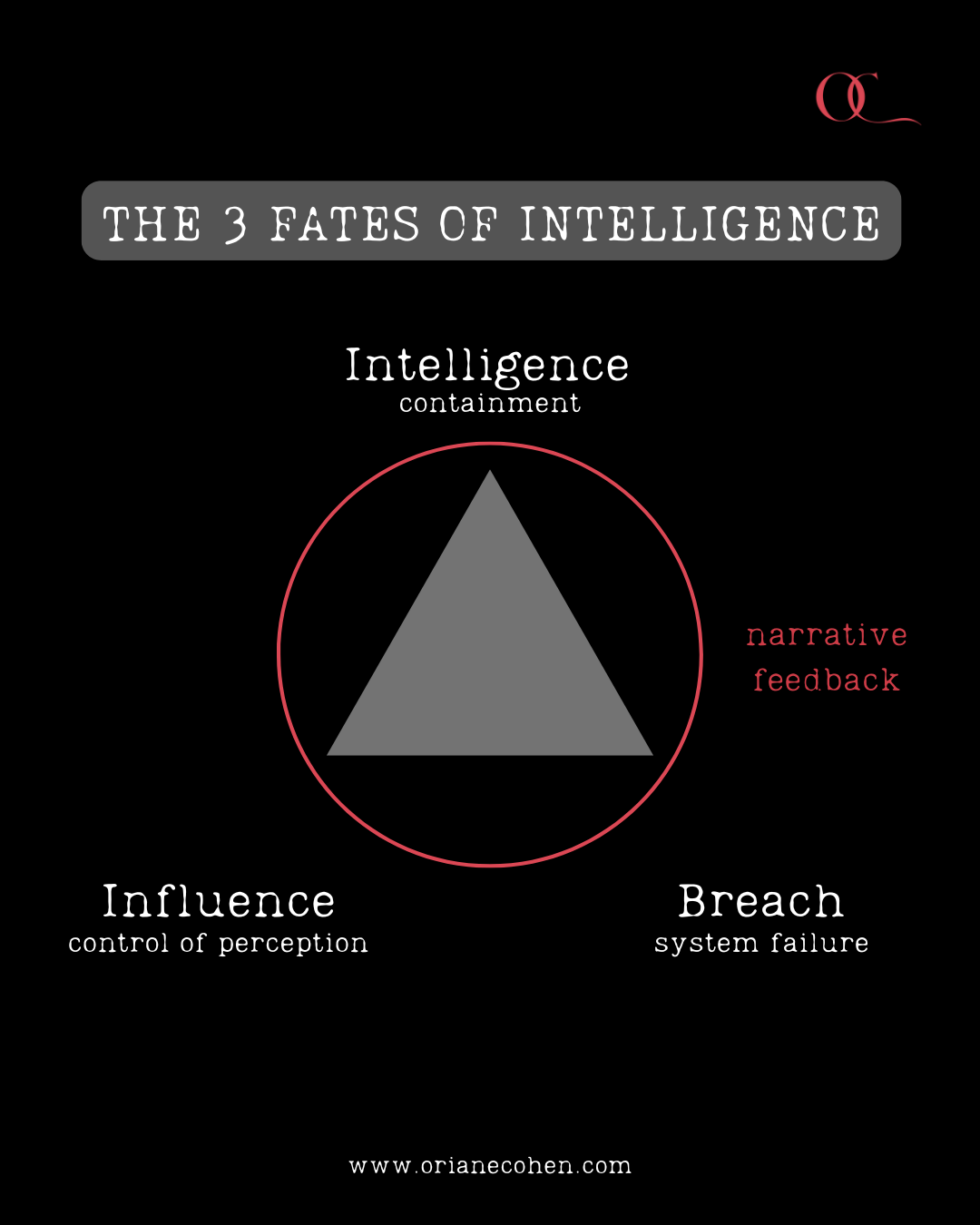
So when someone operating at that level produces a clean, linear story like the one we're just about to dissect, understand that you are not looking at intelligence at all.
The architecture is way too clean
The first thing that struck me was the sequence. The letter unfolds like a narrative arc much more than an institutional resignation letter.
Each paragraph serves a narrative function, it's almost like a textbook progression:
Members get the full structural breakdown: the narrative architecture of the letter, the Grey Zone mechanism, and the strategic implications.