Calling Palantir a "spy tech company" is intellectually lazy.
Yet, the "spy" label persists. This framing shortcut comes from a visible fact: some of Palantir's clients are intelligence agencies and state institutions.
From there, the label collapses everything into the word "spy". A word carrying an entire narrative of secrecy, surveillance, clandestinity and illegality.
It is a compression. And like most compressions, it distorts more than it reveals.
The problem with this laziness is that it misplaces Palantir entirely in the value chain.
Surveillance is about collection. But Palantir does not operate at the level of collection, at all.
That's what Palantir's clients do, before using Palantir. States and large organizations already harvest data at massive scale. They don't need Palantir for that.
What they lack is the ability to turn that accumulation into something they can actually see and act on.
Palantir operates after collection and it is there, in the structuring of what already exists, that something more consequential happens.
Today we will ask the only question that matter: what kind of reality does a system produce when it becomes the interface through which institutions perceive, decide, and act?
I will argue three things:
First, how Palantir transforms raw, fragmented data into an operational model of reality through what it calls an ontology.
Second, why this model is not neutral: it rests on the assumption that reality can be fully formalized (a long-standing ambition in science and philosophy, with clear limits).
Third, what this changes in practice once decisions are mediated through such systems.
Palantir structures decision.
States and large organizations collect data at scale:
- administrative records
- financial flows
- mobility patterns
- communications metadata
- operational logs
The problem is making that data usable for decision-making, because raw accumulation produces nothing but... noise.
Palantir provides the missing layer: the ability to transform fragmented, heterogeneous data into a coherent operational model.
At scale, this changes the nature of what institutions can do with data.
The more data is accumulated over time, the more it becomes possible to reconstruct sequences of events, identify patterns of behavior, connect actors across systems, contextualize decisions within longer trajectories.
Not to "rebuild lives" in some abstract way. But to reduce uncertainty about how systems evolve.
This is where Palantir derives its value. It compresses uncertainty into structured, actionable knowledge.
But compression always involves a choice about what to keep and what to discard. To understand that choice, you need to look at the concept Palantir explicitly places at the center of its architecture: ontology.
In philosophy, ontology is the study of being. It helps categorize what exists and how things are related.
Inside Palantir, it becomes operational:
- Objects represent entities (aircraft, individuals, supply chains)
- Links represent relationships (dependencies, flows, hierarchies)
- Actions trigger operations (what can be done inside the system)
Palantir becomes a layer between reality and decision making. And leaders act on a representation of reality structured within the system.
The hidden assumption: reality can be modeled
Palantir's CEO Alex Karp is not an engineer who borrowed philosophical vocabulary. He is a philosopher, who built an engineering system.
Terms like "ontology", "coherence", "structure" reflect an underlying assumption: reality can be modeled and made operational through structured relationships.
This assumption is one of the central ambitions of modern science.
At its most precise, it appears in physics: the search for a unified description of the fundamental forces of nature.
Albert Einstein spent the later part of his life trying to develop a unified field theory, an attempt to describe gravity and electromagnetism within a single mathematical framework.
He did not succeed.
Since then, the same ambition has continued through the quantum field theory, string theory and attemps at a "theory of everything".
All share the same intuition that the complexity of the world can, in principle, be reduced to a consistent underlying structure.
At the level of formal systems, this ambition encounters known limits.
Michael Polanyi called it "tacit knowledge": the dimension of human understanding that cannot be fully articulated.
A doctor who recognizes a diagnosis before she can explain it. A general who senses a shift in the battle before the data confirms it. An analyst who knows something is wrong before the model flags it.
This is not irrationality. It is a form of knowledge that precedes formalization and it is precisely what structured systems cannot capture by design.
This does not invalidate modeling. But it sets a boundary that no increase in data volume or processing power can dissolve.
The limit is epistemic.
You can have complete data and still hesitate. You can have a coherent model and still sense something is off.
That gap is a feature of how humans relate to reality. And it marks the boundary of what can be formalized. It does not disappear because a system cannot capture it. But it does become weaker if the system becomes the interface through which reality is approached.
"Model reality, not systems" and the cost of coherence
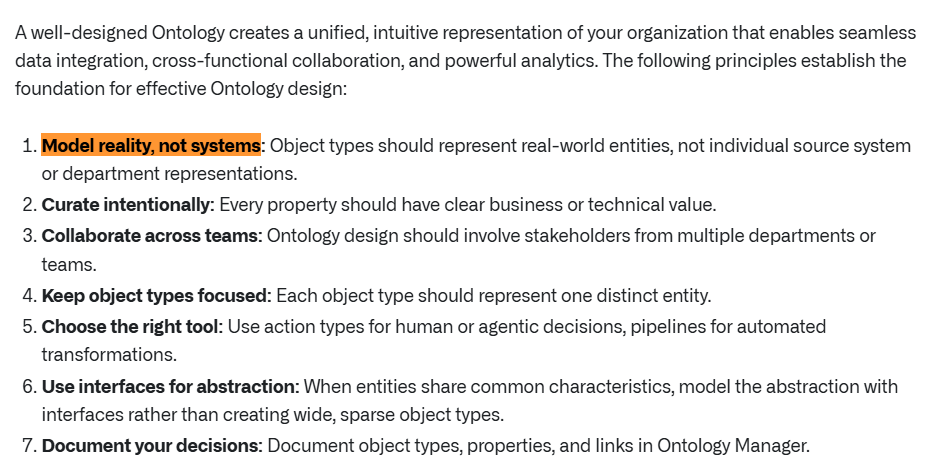
Palantir's design principle is explicit: model reality, not systems.