


May 10, 1933. Berlin, Opernplatz.
40,000 people gathered in front of the Opera House. University students - from Humboldt, Munich, Heidelberg - marched with torches and threw roughly 20,000 books into a bonfire.
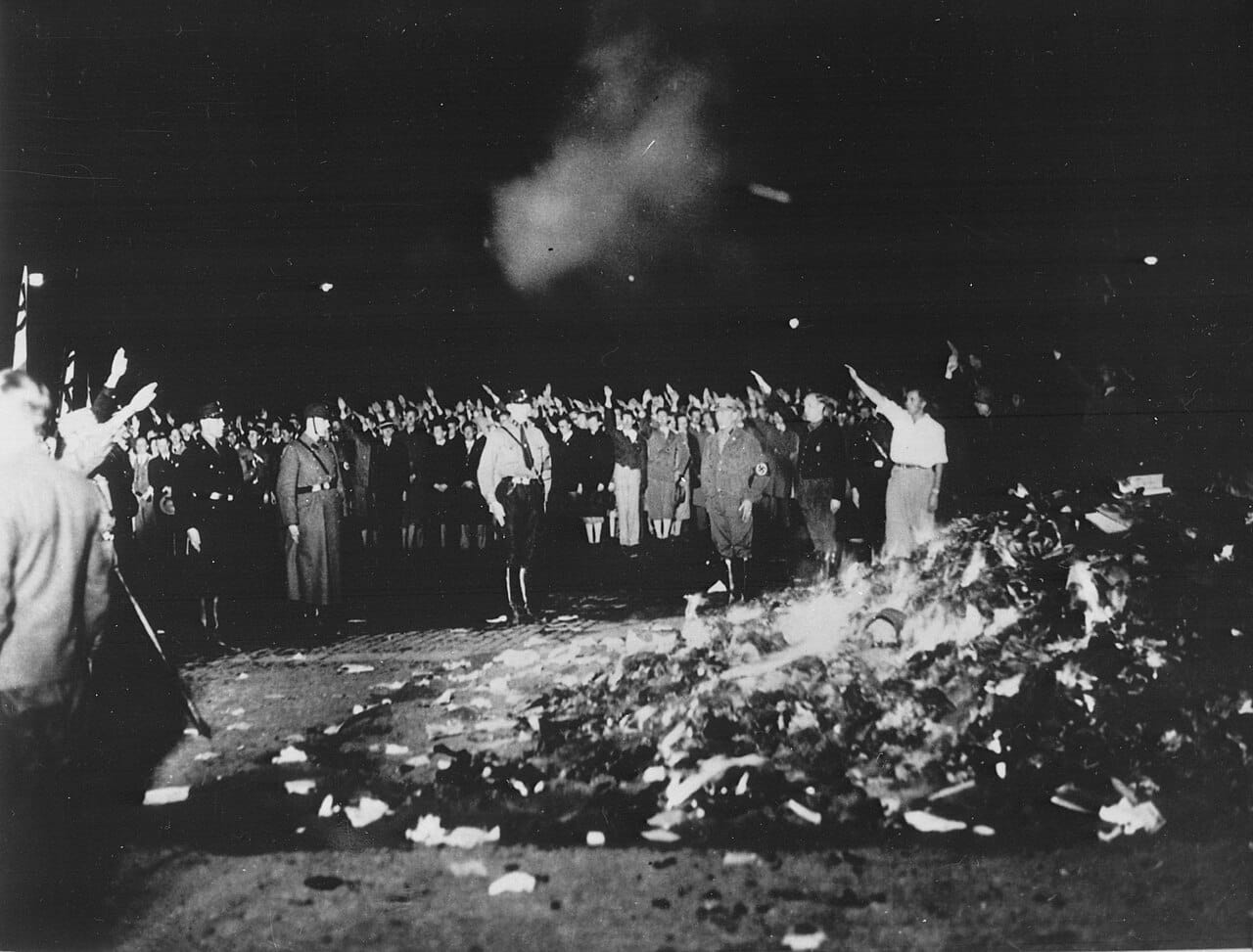
The books had been pre-selected from blacklists compiled by a Nazi librarian named Wolfgang Hermann.
Nine categories of books: from Bolshevist to Jewish literature, morally depraved to pacifist and "un-German".
The students didn't choose the books themselves. Someone else made the list. They just showed up and threw.
Among the works consigned to the fire:
Freud. Because he argued the human mind contains forces it cannot fully control or see. Because the self, in his work, is not unified, not transparent, not pure. Because if Freud is right, the idea of a clean, uncorrupted people becomes impossible to sustain.
Einstein. Because his work destabilized the idea of a single fixed frame of reference. He developed the theory of relativity. And a regime that needs absolute truth cannot afford an Einstein.
Marx. Because he insisted that power shapes what we call normal. Because he made the invisible structures of a society visible. Because visible structures can be questioned.
Zweig. Because his novels were populated by people who didn't fit, people torn between worlds, between identities, between loyalties. Because ambivalence, in his hands, was not weakness. It was the condition of being human.
This was exactly 93 years ago.
An auto-da-fé (public book burnings) is never the beginning of something. It’s actually the end, of an invisible process.
By the time the fire appears, the selection has already been made.
That process has a function: the compression of reality.
When a system can no longer absorb complexity, it reduces it according to a sequence.
First, reality is reclassified. Not debated publicly: renamed. Through language. Categories like "bolchevist" replace analysis.
Then, visibility is reduced. What does not fit the dominant frame is no longer taught or cited. It stops circulating.
Then, the cost of defending it increases socially, professionally. But also politically.
And at some point, it disappears from the field entirely.
The fire only comes last. Today, we don't need to get to the fire.
We do it better.
"Purification" is the justification layer
I want you to sit with one detail: the word Goebbels used was not "censorship". It was Reinigung - purification.
The books were not framed as "being wrong". They were framed as contaminated. And the contamination had a name.