

Despite the movie version, blackmail is rarely the goal. What services want is a lasting relationship the target does not want to end, because what is being exploited is not desire, but the need to be seen.
Every few years, a story breaks with the same ingredients: a powerful man, a woman nobody had heard of. A foreign intelligence service somewhere in the background.
The internet has its verdict ready within the hour.
Honey trap! What an idiot!
I understand the appeal.
Sex, money, power, betrayal: everything is there.
But "honey trap" is one of the most misunderstood terms in intelligence. And the way most people picture it is exactly what makes them easy to approach.
Let me say one thing upfront. This was never my line of work. I was a HUMINT operator, and I never worked romance approaches. I always thought it was a dangerous game.
You don't play with love. Play long enough and you fall for real. You get attached. And once you are attached, you no longer control anything: not the relationship, not the information, not yourself. Therefore you become a danger for yourself, and your organization.
So this is not a guide written from inside the bedroom.
It is what I learned about why these approaches work, why they are rarer than you think, and why the people who are best at this job almost never need them.
What is a honey trap in espionage?
A honey trap is the use of romance, intimacy or sex to approach a person who has something an intelligence service wants: access, information, influence over a decision.
You will also see "honeypot" and "sexpionage".
In espionage, they mean the same thing. In cybersecurity, a honeypot is something else entirely: a decoy system built to lure attackers.
The important point is this: a honey trap is not a separate magic trick. It is one pathway into recruitment among many. The relationship is the door. What matters is what lies behind it.
Why is a honey trap rarely about blackmail?
In the films, it ends with photographs on a table and a man who has no choice. In reality, coercion makes terrible sources.
A person you force resents you. They lie to you. They give you the minimum. They spend their energy looking for a way out, and the day they find one, they may take you down with them.
This is why, in the MICE model (Money, Ideology, Compromise, Ego), compromise is the most fragile lever of all. I explain why these models are only a starting point in MICE vs RASCLS.
What a service really wants is the opposite: a relationship that lasts, that the person enters freely, and that they do not want to lose. As a former FBI official put it in Lawfare, it is not the act of sex that is relied upon, but the emotional attachment.
Sex is a detail... Attachment is actual the operation.
What does a honey trap really exploit? Love, intimacy and the need to be seen
We are born unfinished. Our first experience of life is need: warmth, protection, presence. From the very beginning, love and survival are wired together.
That is why love overrides logic. When we feel loved, the brain releases oxytocin, dopamine, endorphins. We feel safe. And when we feel safe, our threat detection goes quiet. We become less suspicious. Love is blind, quite literally.
But here is what most people miss: the real lever is not desire. It is attention.
Being seen. Being listened to. Feeling special, understood, desired for who you are rather than for what you can give.
Think about who gets targeted. People with access, power, responsibility. People who are surrounded all day and almost never seen. Everyone around them wants something: a decision, a signature, a favour. They are listened to for what they can do, rarely for who they are.
Then someone arrives who seems to want nothing. Who remembers the small things. Who makes the pressure disappear for an evening.
That is not a weakness of stupid people. It is the most human need there is. I wrote about it at length in Why love makes us so vulnerable.
Why don't the best HUMINT operators need seduction?
This is the part that surprises people... The best people in my field are not the most seductive.
They are good because they are, deep down, profoundly... human.
They have an extraordinary capacity to listen. They are reassuring. They make you feel safe. You leave a conversation with them lighter than when you arrived.
Being a friend, a confidant, an attentive ear: most of the time, that is all it takes. People tell you their lives because, for once, someone is really listening.
And that is exactly why romance is unnecessary, and dangerous. It adds a variable nobody controls. Feelings grow on both sides. Jealousy, guilt, real attachment. An operation built on love can collapse, or turn, for the most human of reasons.
If you want to understand how intelligence people read others, start with what HUMINT knows about human behavior under pressure.
How does a romance approach really work?
If you imagine a mysterious stranger walking up to a powerful man in a hotel bar, you are looking for the wrong thing. Or you just watched too many movies.
People with influence meet clients, investors, executives and officials all the time. They go to the same conferences, have dinner together, introduce each other to their networks. Those encounters have a real purpose. The companies can be real. The business can be real.
And some of the people in the room may also have interests they do not disclose.
In broad terms, an approach tends to follow the same logic:
- Spotting: who has access, and what is missing in their life (attention, recognition, comfort, escape).
- A natural meeting: a context where the contact makes sense and raises no questions.
- The relationship: time, trust, the feeling of being understood like never before.
- Small asks: an opinion, a name, a document "just to understand". Each step is tiny. None looks like betrayal.
- Dependency: the relationship now matters more than the rules around it.
There is also a quieter version. A service does not always need to place someone. It can approach a partner who is already there, while the affection is real and already in motion. Which makes these cases extremely hard to prove: the feelings may be genuine, and the recruitment may come later.
The late-2026 reports around Nvidia's then-CEO and a Singapore-based executive are a good example of that uncertainty. US officials have said they have not determined that she spied for China.
Yet many people decided within hours exactly what had happened.
The questions that matter are less entertaining. What access did the relationship provide? What information was available? What, if anything, was compromised?
Why do we enjoy mocking the target?
Whenever a powerful person falls for it, the same pleasure spreads: Schadenfreude. Watching someone above us humiliated.
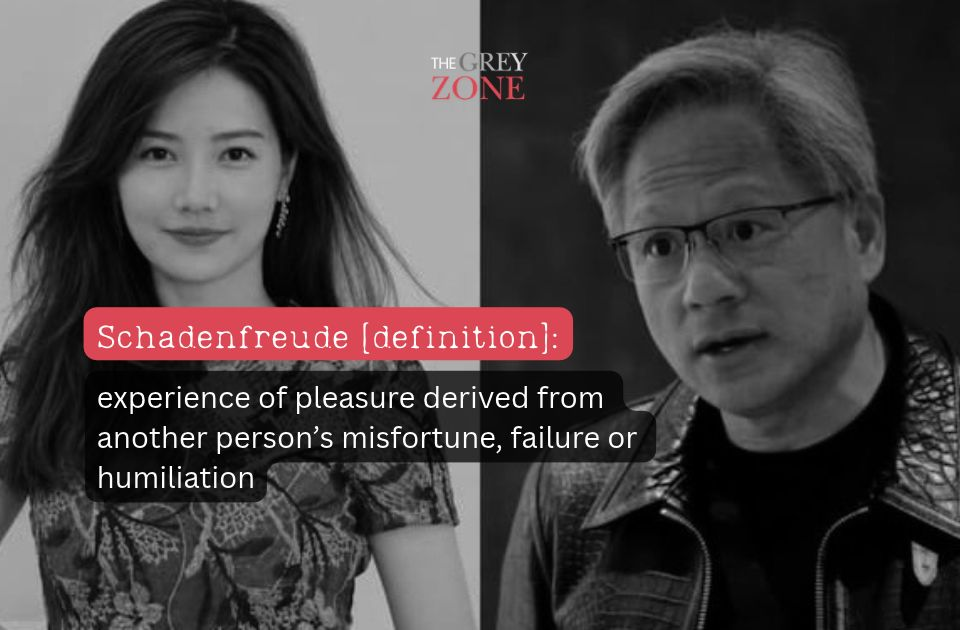
But turning the target into an idiot does something else. It makes you feel immune.
"A guy like him should have seen it coming. I would have seen it coming."
But... would you?
The moment you reduce these stories to "a stupid man and a beautiful woman", you stop asking how access works. And you stop looking at the one place it could happen next: your own life.
Why do we hear about honey traps when we do?
When an intelligence story reaches the front page, ask a second question: why am I reading this now?
Services sometimes know about an approach and keep watching. That can look shocking from the outside. It rarely is.
Years ago, a man came to the organization I worked for. He had spent months digging on his own into the people we were after. He meant well. He had a whole file and wanted to make it public, to "make justice".
Problem: we had been working on that operation for almost two years. We could see who came in, who made decisions, and how. If he went public, the people we were watching would change how they operated the next morning. Two years, gone.
I have also been on both sides of the mirror: the journalist chasing the scoop, and the person who wanted something on the front page. A reporter can check every fact, land a genuine scoop, and still not know what their source wanted to happen when the story went live.
There are only three fates for intelligence:
- It is released intentionally: that is influence.
- It is leaked accidentally: that is a breach.
- It is contained successfully: that is intelligence.
The same disclosure can be a breach for the people who wrote the report and an opportunity for the person who shared it.
How can you spot a honey trap early?
There is no checklist that protects you from love. But some patterns should make you pause:
- Intimacy moves faster than usual. You feel understood like never before, very quickly.
- Interest drifts toward your work. Your projects, your access, your colleagues, your travel.
- You become slightly isolated. The relationship takes space, and it prefers discretion.
- The asks come in small steps. Each one is reasonable. Together, they draw a line.
- Help creates debt. Gifts, introductions, favours you never asked for.
None of these proves anything. Real love can look like this too. That is the whole difficulty.
Spotting an approach is not intuition. It is a skill, and it can be trained. This is what I teach in The Grey Zone Protocol: how to read intentions, patterns and pressure before they become a problem.
 Oriane Cohen

If something feels off, do not investigate alone and do not confront. Stop sharing work details, keep notes, and talk early to your security officer or your country's counterintelligence service. It is not shameful. Being targeted usually means you matter.
For organizations, the lesson is wider. One of the most valuable assets of any company walks on two legs: the people who hold the relationships and the access. Know who they are, and what would happen if someone else knew it first. I explain the early warning signs inside companies in The silent signs of an insider threat.
If you are responsible for protecting a team or a company, Insider Threat: The Playbook shows how people are spotted, approached and turned, and how to build defences that work with human nature rather than against it.


Love is not the problem. Unconscious love is.
The real power is to love without becoming blind. To connect without becoming dependent. To care without being played.
FAQ
What is the difference between a honey trap and a honeypot? In espionage, both mean using seduction to gain access or information. In cybersecurity, a honeypot is a decoy system designed to lure attackers.
Is a honey trap always about sex? No. The core lever is emotional attachment and the need to be seen. Sex may be part of it, but attention does most of the work.
Do intelligence services still use honey traps? Yes, but less often than films suggest. Trust, friendship and attentive listening achieve most of what romance promises, with far less risk.
Can a honey trap involve real feelings? Yes. A real relationship can be recruited after it begins, and an operator can fall in love too. That is why intent is so hard to prove.
What should I do if I think I am being targeted? Stop sharing work details, keep notes, and contact your security officer or national counterintelligence service early. Do not investigate or confront alone.
Stay lucid,
Oriane
Honey traps work because nobody believes they could be a target. The Grey Zone reads the operations that rarely make the headlines, from someone who has worked with sources.
Learn to spot it: The Grey Zone Protocol · Protect your organization: Insider Threat: The Playbook · Go deeper: Cognitive Security