


Someone recently asked me that question: "will there be a new country in the Middle East?"
The question sounds speculative. It isn't. Because for the first time in decades, multiple political entities across the region are forcing us to reconsider what a country actually is.
Gaza has been governed as a political-military entity without being a state. Hezbollah is not a state, yet it exercises armed sovereignty inside Lebanon. The Houthis are not recognized as a government, yet they control territory and shape maritime security in Yemen. In northeastern Syria, Kurdish-led administrations have operated as a de facto autonomous system for years.
None of these are "countries" in the classical sense. All of them exercise power.
More importantly, similar dynamics are beginning to appear far beyond the Middle East.
Technology companies shape the behavior of populations larger than most states.
Financial networks operate across jurisdictions.
Religious transnational movements mobilize loyalties that transcend borders.
Digital communities increasingly organize themselves as political actors.
The Middle East is simply the place where these contradictions became impossible to ignore.
That is why the question is interesting. When someone ask about "new countries" they assume a specific model: a territory with clear and stable borders, a recognized government/authority, a flag, an anthem, a seat at the UN, a "people".
A nation-state.
But this model is an anomaly. The nation-state model is historically recent, structurally instable and often violent in its conception. It imposes a form of coherence, pretending to absorb all minorities, and deep substrates of a society.
So the real issue is not whether a new country in the Middle East will emerge. It's whether the concept of "country" still describes how power actually works.
In this brief, we're going to use the Middle East as a case study. But don't get it wrong, it isn't a piece about the Middle East. It is about the transformation of what we call "sovereignty".
TL;DR
- The map is stable, but reality is not: the Sykes-Picot time bombs
- What is a "country" actually
- Where the model breaks in the Middle East: Yemen, Lebanon, Syria
- The Palestinian case
- So will there be a new country in the Middle East?
The map is stable, but reality is not.
I've always had a problem with geopolitical maps. Cartographers draw the world as if it was stable. Fixed. Legible.
But borders are not neutral, they are decisions.
Take India and Pakistan.
The border between India and Pakistan was drawn in 36 days by a British lawyer, Cyril Radcliffe, who had never been there before. He drew the line, without taking into account local complexities, then left. This line gave birth to two modern nation-States.
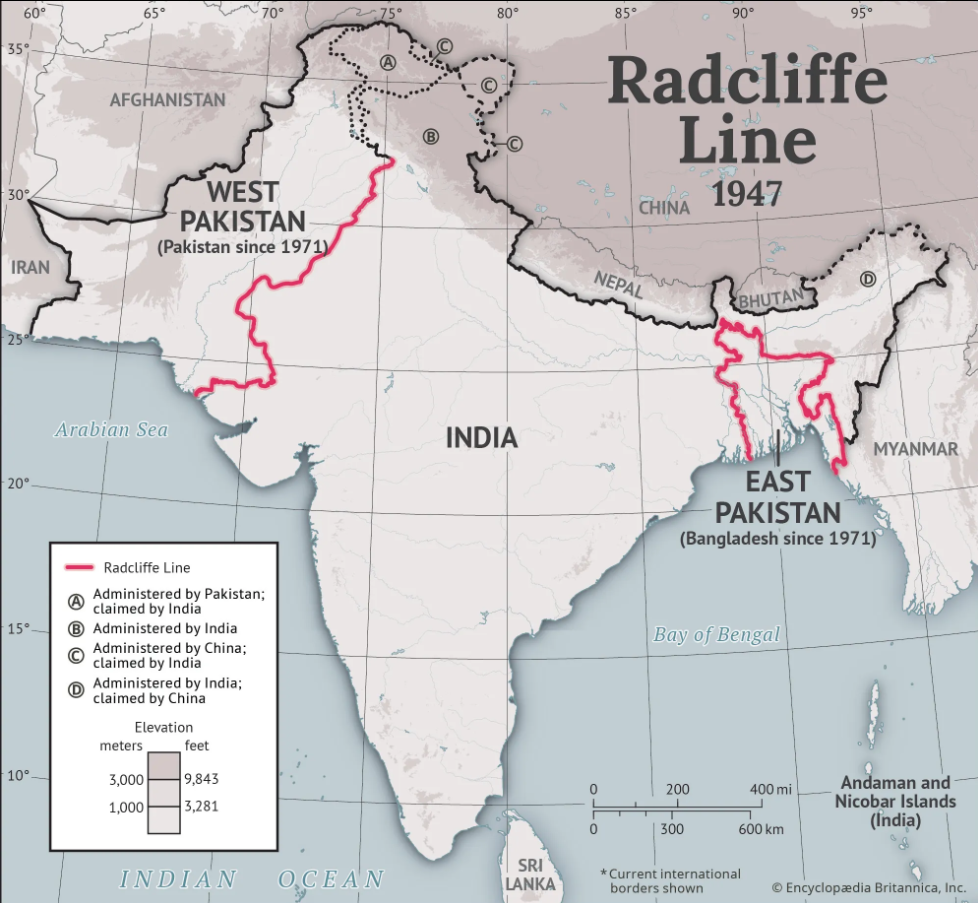
Millions of people paid the price.
Radcliffe wrote, after his return to the UK, that he didn't want to be found, very well aware of his own incompetence and the terrible consequences in reality that the line he drew had created.
Radcliffe's case is not an exception. It is a method, or more specifically, a symptom.
For most of history, borders followed the world as it was: rivers, mountains, deserts, seas - geography imposed its own logic.
The Rhine, the Pyrenees, the Himalayas, the Mediterranean structured political space because they structured physical reality. They created natural barriers, logistical constraints, zones of separation.
Borders were, in a sense, legible. They described something real.
But many modern borders, especially those produced during the colonial era, were drawn differently. From administrative logic, imperial negotiations, resource access, and strategic convenience.
The Middle East became one of the clearest expressions of this process. Borders were engineered.
In 1916, the Sykes-Picot Agreement divided the collapsing Ottoman territories between British and French zones of control. Mark Sykes represented British interests, François Georges-Picot represented French ambitions.
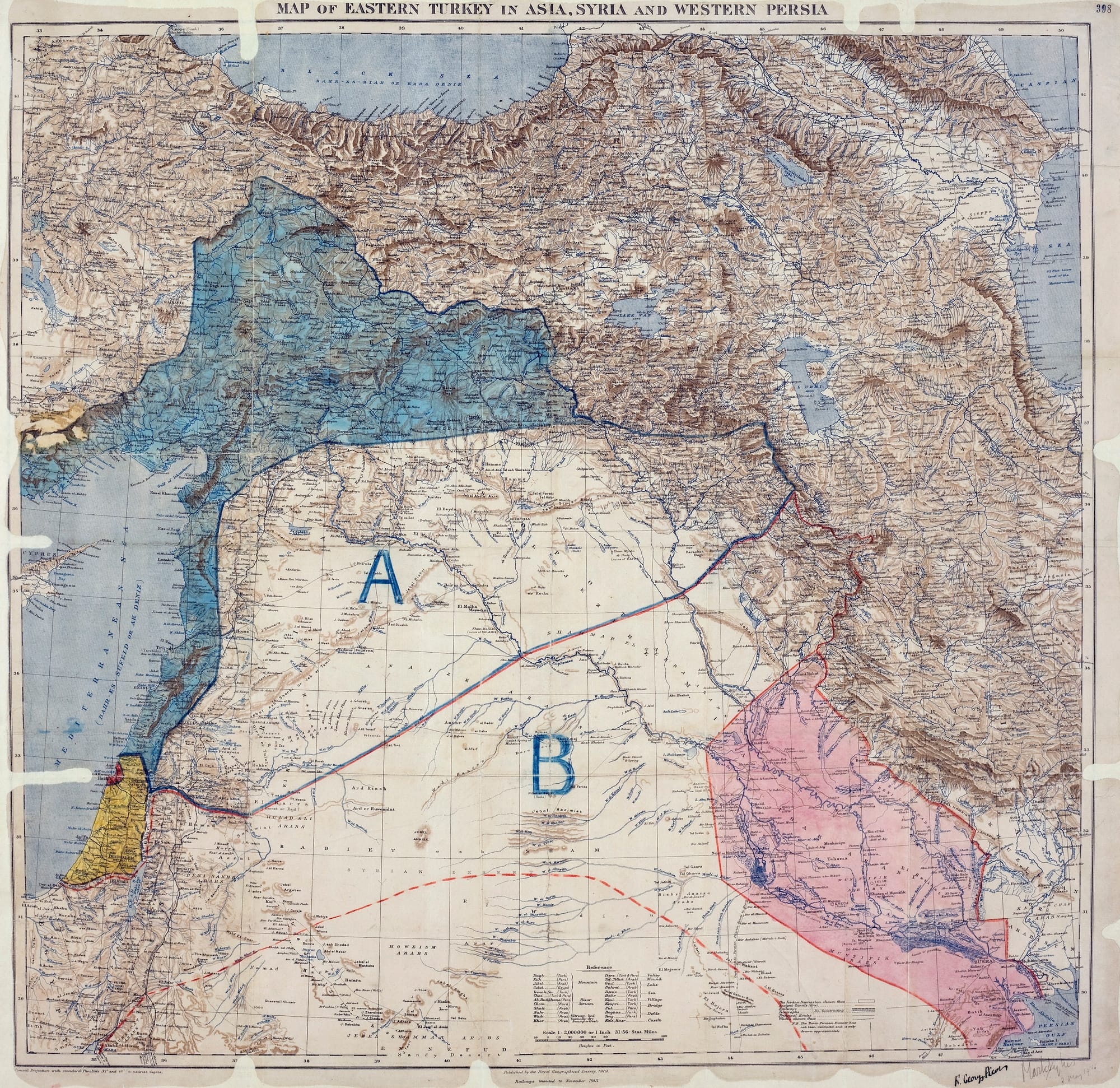
These were not empty lands.
They were dense civilizational layers - Sunni and Shia Arabs, Kurdish populations stretching across four future states, Jewish communities, Maronite and Orthodox Christians, Druze, tribal systems with their own loyalties, urban elites shaped by Ottoman administration.
Heterogeneous, layered, ancient and forced into the same containers.
These borders were designed to organize control. And yet, despite their artificiality, they have become extraordinarily resistant to change. Because they are, somehow, still very useful.
Sykes-Picot created structural time bombs.
Iraq was assembled from three irreconcilable centers of gravity - Sunni Arab elites, a Shia majority, and a Kurdish north.
Lebanon was engineered as a Christian-majority state over a demographic reality that was already something else.
Syria was held together by the brute force of a centralized authoritarian structure.
None of these were nations. They were managed constructs held in place by the shared cost of dismantling them.
Because yes, dismantling them today would be more destabilizing than maintaining them. Turkey will not allow a Kurdish state on its borders. Iran protects its Shia influence corridors at any cost. Saudi Arabia counters Iranian expansion wherever it can. Israel operates on security depth and strategic ambiguity. External powers manage the balance without ever redesigning it.
The result is a paradox that defines the entire region: these borders are historically arbitrary but politically untouchable.
What is a "country" actually ?
Before asking whether a new country could emerge in the Middle East, we should first ask a simpler question: what is a country?
The answer seems obvious until we look closely.
A country is not a natural object. It is not something that exists in nature like a mountain. It is a political construction.
More precisely, it is an attempt to align several different realities that do not naturally overlap. At least five distinct layers are hidden behind the word "country":